
There are many things happening at school every day. There is laughter among friends, conversations in the corridors, messages exchanged through mobile phones, and countless stories that adults may never see.
Yet behind these ordinary moments, a young person may be facing something difficult. They may be experiencing bullying, receiving threats online, facing violence at home, or simply choosing to remain silent because they do not know whom to trust.
This is why child protection is not only the responsibility of adults. Children and young people can also play an important role by becoming caring friends, recognizing signs of violence, and knowing where to seek help when something does not feel safe.
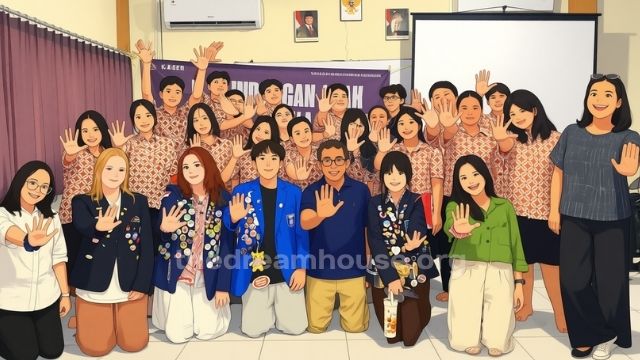
This spirit was at the heart of the Child Protection Cadre Training at School, organized by The Dreamhouse Indonesia Foundation on Wednesday, September 2, 2026, at SMK Bopkri 1 Yogyakarta.
The training brought together 15 students who are being prepared as child protection cadres from SMK Bopkri 1 Yogyakarta, along with four students from Rotary Youth Exchange Yogyakarta. The activity was also supported by Rotary Club of Jogja Merapi (RCJ Merapi) as part of a shared commitment to strengthening child protection and meaningful child participation in schools, as stated by the RCJ Merapi’s President, Sammy Ladh.
Recognizing Violence That Is Not Always Visible
One of the main topics explored during the training was the different forms of violence that children and young people may experience.
Participants learned about physical violence, including hitting, kicking, and pushing. They were also reminded that violence does not always leave visible physical injuries.
Psychological violence can take the form of humiliation, intimidation, threats, exclusion, or words that repeatedly make someone feel worthless.
The participants also discussed sexual violence, including sexual harassment, online sexual exploitation, and grooming. In today’s digital environment, they explored cyberbullying as another form of violence that can happen through social media and digital platforms—from insults and rumors to the sharing of private content without consent.
These discussions connected directly with the everyday lives of young people because violence can occur in the places where they spend much of their time: at school, among friends, and online.
When Violence Changes the Way Someone Sees Themselves
The training also introduced participants to Viktor Frankl’s ideas on logotherapy and the relationship between traumatic experiences and the search for meaning in life.
Violence does not only hurt the body. It can also affect how a child sees themselves, other people, and their future.
A young person who is repeatedly humiliated may begin to believe that they are worthless. Someone experiencing bullying may feel that there is nowhere safe for them. Survivors of sexual violence may struggle with a sense of control and with rebuilding their understanding of their own worth.
From Frankl’s perspective, human beings have the capacity to search for meaning even in the midst of suffering. For children who experience violence, however, this journey requires appropriate support and a safe environment.
Recovery should never have to happen alone.
A friend who is willing to listen, a trusted teacher, a supportive family member, a mentor, or a safe community can all become part of a child’s journey toward hope and healing.
Learning Through Cases, Not Just Theory
The training went beyond presentations and theoretical discussions.
Participants were invited to analyze case studies involving violence against children. They explored how to identify different forms of violence, understand their possible impact, and consider appropriate ways to respond and provide support.
Group discussions also created opportunities for participants to reflect on situations they had witnessed or heard about in their own communities.
At the same time, conversations about violence and trauma were approached carefully. Participants were reminded that when someone has experienced something painful, the goal should never be to pressure them into telling their story.
Creating safety means respecting boundaries, listening without judgment, and allowing people to decide what they are ready to share.
Participants learned that being a child protection cadre does not mean having to become a “rescuer” for everyone.
Sometimes, being a safe friend simply means listening, avoiding judgment, respecting confidentiality appropriately, and helping a friend connect with a trusted adult or professional support.
Learning to Notice the Signs
Another important part of the training was learning to recognize possible signs that a child may be experiencing violence.
Sudden changes in behavior, excessive fear, withdrawal from friends, significant emotional changes, or unexplained physical injuries may all be signs that deserve attention.
However, one sign alone does not necessarily mean that a child is experiencing violence.
For this reason, participants were encouraged not to jump to conclusions or make accusations. What matters is learning to notice, care, and know when to seek help.
Sometimes, simply paying attention to a change in a friend’s behavior can become the first step toward helping them feel less alone.
Children Are Not Only Recipients of Protection
For The Dreamhouse Indonesia Foundation, strengthening child protection also means creating opportunities for children to participate.
Children and young people are not only people who need protection. They also have voices, experiences, ideas, and the capacity to contribute to safer communities.
Child protection cadre training is one way of strengthening that role. With the right knowledge and support, students can help build a school culture where the safety and well-being of every student are valued.
A safe school is not created by rules alone.
It is also built through relationships—when students have the courage to say that violence is not acceptable, when a young person feels safe enough to ask for help, and when someone chooses not to remain silent.
Brave Enough to Care
In the end, being a child protection cadre is not about having all the answers. It is about having the courage to notice. The courage to listen. And the courage to say, “You are not alone.”
Through the collaboration of The Dreamhouse Indonesia Foundation, SMK Bopkri 1 Yogyakarta, Rotary Youth Exchange Yogyakarta students, and the support of Rotary Club of Jogja Merapi, this training became another small but meaningful step toward creating safer and more child-friendly school environments.
Because child protection is not only about responding when violence has already happened. It is also about creating environments where every child feels seen, heard, respected, and safe enough to ask for help. And perhaps, change can begin with something as simple as one student choosing to care.