
Building a safe environment for children cannot be achieved by one party alone. Families and communities must work together to ensure that every child enjoys their rights, is protected from violence, and has the opportunity to grow and develop.
There are many things happening in a child’s life that adults may not always see. A child may be experiencing violence at home, bullying among peers, neglect, or other forms of exploitation. Not every child is able to speak about what they are going through. Some remain silent because they are afraid, ashamed, or simply do not know whom they can turn to for help.
This reminds us that child protection cannot rely solely on the existence of institutions or formal protection services. The people closest to children, especially their families and communities, must become an essential part of prevention and protection efforts.
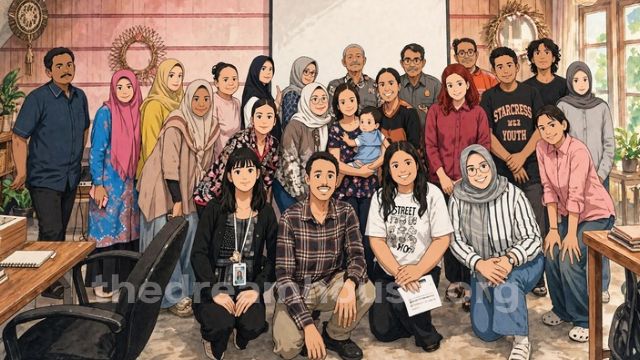
With this understanding, Yayasan Rumah Impian Indonesia (The Dreamhouse Foundation) organized a Workshop for Parent Volunteers in Child Protection on Saturday, 31 October 2026, at Rivea Cafe & Co-Working Space, Seturan, Yogyakarta. Carrying the theme “Caring Parents, Protected Children: Together Building a Safe Environment,” the workshop aimed to strengthen parents’ involvement in creating safer communities that are more responsive to children’s protection needs.
The workshop was a continuation of a series of child protection training sessions attended by parents from Dreamhouse’s assisted communities throughout 2024–2026. Through this activity, prospective parent volunteers were prepared to take a more active role in identifying risks, providing initial support, and connecting children and families with appropriate protection services.
Child Protection Begins in the Immediate Community
The workshop featured Mr. Nyadi Kasmoredjo, Chairperson of the Yogyakarta Special Region Forum of Child Welfare Institutions (Forum LKSA DIY), as the main resource person.
In his presentation, he emphasized the important role of parents and communities in recognizing issues that may threaten children’s safety and well-being.
One important point discussed was that children facing difficulties may not always be able to express their feelings directly. Changes in behavior, such as suddenly becoming withdrawn, unusually quiet, or behaving differently from usual, should receive attention from parents and other adults around them.
Parents need to create a safe space where children feel comfortable sharing their experiences. Listening with empathy, avoiding judgment, and refraining from blaming children are essential first steps. When further assistance is needed, parents should also know how to connect children with professionals such as social workers, doctors, or psychologists.
In this context, parent volunteers are not expected to solve every problem a child faces. Rather, they serve as caring adults who can recognize warning signs, provide initial support, and help children and families access appropriate assistance.
Understanding and Upholding the Four Fundamental Rights of Children
An important part of the workshop was introducing the four fundamental rights of children, which serve as the foundation for all child protection efforts: the right to life, the right to protection, the right to growth and development, and the right to participation.
Understanding these four rights is essential because child protection is not simply about preventing violence. It is also about ensuring that children’s needs and best interests are recognized and fulfilled.
1. The Right to Life: Ensuring Every Child Has an Identity and Access to Basic Needs
Every child has the right to life, to have a legal identity, and to access the basic services necessary for their well-being.
During the workshop, the speaker specifically highlighted the importance of children’s civil registration documents, including birth certificates and Child Identity Cards (KIA).
Legal identity is more than just an administrative document. Birth certificates and other civil registration documents provide the foundation for children to access essential services such as education, healthcare, social protection, and other rights.
Special attention was also given to children born without an officially recorded father’s identity, children abandoned by their parents, and children facing difficulties obtaining civil registration documents.
Through this understanding, parent volunteers are expected to help families experiencing difficulties with their children’s documentation and connect them with social workers and relevant authorities.
2. The Right to Protection: Keeping Children Safe from Violence and Exploitation
Every child has the right to be protected from physical violence, sexual abuse, exploitation, neglect, discrimination, and other forms of treatment that threaten their safety and dignity.
The Parent Volunteer Child Protection Handbook introduced during the workshop provides guidance on recognizing different forms of threats against children and understanding the initial steps to take when concerns arise.
Volunteers are expected to develop the awareness needed to recognize warning signs, listen to children without blaming them, and help connect them with appropriate protection services.
Equally important is understanding the boundaries of a volunteer’s role. Volunteers must not conduct their own investigations, disclose children’s identities or sensitive information, or attempt mediation that could place a child at further risk.
Whenever there is a suspected case of violence or a threat to a child’s safety, the priority must be to ensure the child’s safety and immediately coordinate with the appropriate authorities or protection services.
3. The Right to Growth and Development: Creating a Safe and Supportive Environment for Children
Children need more than protection from harm. They also need an environment that supports their physical, mental, social, and emotional development.
The right to growth and development includes opportunities to receive education and healthcare, experience proper care, play, and develop their potential and abilities.
Parents therefore have an important responsibility to establish positive parenting practices, pay attention to their children’s needs, and build healthy family relationships.
During the workshop discussions, participants raised several issues commonly encountered in family life, including situations where children leave home because they feel uncomfortable and are frequently scolded by their parents.
Such situations require adults to be willing to listen to children’s experiences and understand what makes them feel unsafe. Engaging with families is also necessary to encourage healthier communication and more positive parenting practices.
Through the involvement of parent volunteers, Dreamhouse hopes that more families will recognize that home should be the safest place for children to grow and develop.
4. The Right to Participation: Giving Children the Opportunity to Be Heard
Children are not merely recipients of protection. They also have the right to express their opinions and feelings and to be heard in matters affecting their lives.
Respecting children’s right to participation begins with parents’ willingness to listen, value their opinions, and involve them in decisions appropriate to their age and level of maturity.
In child protection, the ability to listen is particularly important. Children who feel heard and are not judged are more likely to find the confidence to speak about problems they may be experiencing.
Parent volunteers are therefore encouraged to promote open communication between parents and children. Children need to know that they have a safe space to speak, ask questions, express discomfort, and seek help whenever they encounter unsafe situations.
These four fundamental rights are interconnected. A child who has a legal identity but is not protected from violence does not fully enjoy their rights. Similarly, a child who is protected from abuse but lacks opportunities to learn, play, develop, and express their opinions is still being denied important aspects of childhood.
Building a Network of Parent Volunteers in Dreamhouse Communities
Beyond the presentations and discussions, the workshop also provided an opportunity to strengthen the coordination structure among prospective parent volunteers across Dreamhouse’s assisted communities.
During the preparation session facilitated by Endang Zega and Yashua Lapudooh, a coordinator and volunteer members were appointed for each community. Umi Ayu from Tlukan was selected as the coordinator of the parent volunteers.
The volunteer network brings together parents from several communities, including Sidomulyo, Kalasan, Wonocatur, Tlukan, Wates, and Nologaten.
This structure is expected to strengthen communication and coordination among members while ensuring that each community has people who can serve as a point of contact when child protection concerns arise.
Participants also received the Parent Volunteer Child Protection Handbook as a practical guide for carrying out their responsibilities. The handbook covers children’s fundamental rights, different forms of threats against children, the role of parents in child protection, and mechanisms for reporting and case assistance.
With this guidance, volunteers are expected to develop a clearer understanding of what to do when they encounter situations that may endanger a child, whom to contact, and how to ensure that any response prioritizes the child’s safety and best interests.
Becoming Adults Who Are Present and Caring
For Yayasan Rumah Impian Indonesia, strengthening the role of parent volunteers is part of a broader effort to build a family- and community-based child protection system.
Our experience in supporting children at risk has shown that the challenges children face are often interconnected. Parenting difficulties, family economic conditions, limited access to education and healthcare, violence, and exploitation can all influence one another.
This is why child protection should not begin only after a case has occurred. Prevention must start within the environments where children live their everyday lives.
Families, neighbors, schools, communities, and service institutions need to build a shared commitment to protecting children. We do not have to be experts to begin caring, but we do need to learn how to respond appropriately when a child needs help.
A parent volunteer may not be able to solve every problem a child faces. However, the presence of an adult who is willing to listen, refrain from judgment, and help find the right assistance can make a meaningful difference.
Through this workshop, Yayasan Rumah Impian Indonesia hopes that parent volunteers will become part of a more caring, attentive, and responsive community that recognizes and acts upon children’s protection needs.
Because every child deserves a safe home, a caring family, and a community that supports their dreams.
Child protection is not the responsibility of parents or institutions alone. It is a shared responsibility that belongs to all of us.
Every Child Safe. Every Dream Matters.