
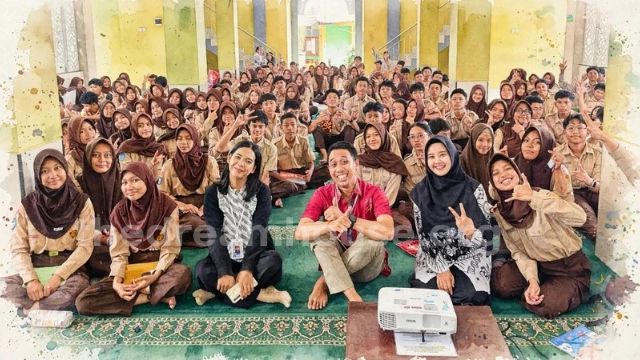
Empathy is not simply about understanding how others feel. It is also about having the courage to take action when we witness injustice. This was the central message shared by Yayasan Rumah Impian Indonesia with students of SMP Negeri 2 Kalasan through a learning session titled “Seeing with Empathy, Acting with Courage.”
On Friday, October 30, 2026, Yayasan Rumah Impian Indonesia responded to an invitation from SMP Negeri 2 Kalasan, Sleman Regency, to share its knowledge and experience on empathy, social discrimination, and the importance of creating an environment where everyone is treated with dignity and respect.
Raka Galih Sajiwo, a social worker at Yayasan Rumah Impian Indonesia, served as the speaker during this Grade 9 co-curricular activity. He encouraged students to understand that discrimination is not simply about differences. It is also about how people perceive, treat, and value others.
Understanding Empathy as the First Step
The session began by inviting students to reflect on how they feel when they see someone experiencing a difficult situation. Through this reflection, they explored empathy as the ability to recognize, understand, and share the emotional experiences of others.
Empathy can be developed through simple actions: listening to a friend’s story, acknowledging another person’s feelings without rushing to judge, and trying to see a situation from the perspective of the person experiencing it.
These abilities are especially important in everyday school life, where children interact with others from different backgrounds, personalities, social circumstances, and life experiences.
Recognizing Stereotypes, Prejudice, and Discrimination
During the session, Raka introduced three concepts that often contribute to discrimination: stereotypes, prejudice, and discriminatory behaviour.
Stereotypes occur when people make assumptions or generalizations about individuals based on their identity or group. Prejudice develops when these assumptions turn into negative attitudes toward a person or group. Discrimination happens when such attitudes are translated into unfair treatment.
These three elements can form a pattern that negatively affects people’s lives. For example, students may experience exclusion or unfair treatment because of where they come from, their skin colour, or their family’s economic circumstances.
Discrimination should never be taken lightly. Children who experience it may lose their sense of safety, struggle with anxiety, experience lower self-esteem, and face difficulties in building social relationships.
This is why schools need to foster an environment where stereotypes and prejudice are challenged before they develop into discriminatory behaviour or bullying.
Choosing Not to Stay Silent
An important part of the session focused on how students can respond when they witness someone experiencing discrimination.
Students were encouraged to become part of a support system for those who are treated unfairly. Practical actions include offering support, listening without judgment, reporting incidents to appropriate school personnel such as counsellors or homeroom teachers, and helping connect affected individuals with professional support when necessary.
Preventing discrimination does not always require major actions. The willingness to listen, accompany someone, and report unfair treatment can become the starting point for meaningful change.
Supporting someone who has experienced discrimination, however, also requires sensitivity. Their experiences and stories must be respected, their privacy protected, and appropriate assistance provided by people with the necessary skills and responsibilities.
Learning from Dreamhouse’s Experience
During the session, Raka also shared Yayasan Rumah Impian Indonesia’s experience in supporting children facing various social challenges, including discrimination.
One of the approaches implemented at Hope Shelter is the establishment of a reporting and support mechanism. Children are encouraged to speak up when they experience or witness discriminatory treatment. Caregivers then follow up on the reports and coordinate with social workers to determine the appropriate support and response.
Dreamhouse also applies Pendekatan Seorang Teman (The Friendship Approach), a mentoring method developed by the founder of Yayasan Rumah Impian Indonesia. This approach emphasizes building sincere, respectful, and caring relationships with children in vulnerable situations.
Being a friend means being willing to be present, listen, respect, and support children without making them feel judged. Through genuine relationships, children are encouraged to feel safe enough to share their experiences and challenges.
In addition, Dreamhouse strengthens child protection initiatives in schools, including its work with student child protection cadres at SMK BOPKRI 1 Yogyakarta. These student cadres are encouraged to become both advocates for a safe school environment and reporters when they identify situations that threaten children’s rights and safety.
These experiences demonstrate that preventing discrimination and protecting children require the involvement of many stakeholders, including children, families, schools, communities, and social service organizations.
Building an Environment Where Every Child Is Valued
The learning session at SMP Negeri 2 Kalasan provided an opportunity to reinforce an important principle: every child has the right to be respected, accepted, and treated fairly, regardless of their background or circumstances.
For Yayasan Rumah Impian Indonesia, creating a child-friendly environment means more than preventing direct violence. It also requires nurturing a culture that respects differences, challenges prejudice, and gives every child the opportunity to feel safe and accepted.
The hope is that students will not only understand the concepts of empathy and discrimination but also put them into practice in their daily lives: when interacting with friends, when witnessing someone being excluded, or when becoming aware of unfair treatment.
Positive change does not always begin with major policies or large-scale initiatives. Sometimes, it starts with one person choosing to listen, one friend having the courage to stand up for someone else, and one community deciding that discrimination should no longer be tolerated.
Seeing with empathy is the first step. Acting with courage is how we show we care.
Yayasan Rumah Impian Indonesia extends its gratitude to SMP Negeri 2 Kalasan for the opportunity and trust to share its experiences and knowledge through this activity. May learning opportunities and collaborations like this continue to grow, helping create safer, more inclusive, and child-friendly environments for every child.
Every Child Safe. Every Dream Matters.